In Mary Shelley’s Frankenstein, there’s a series of letters from the narrator of the novel, Captain Walton, and his sister. In it, he references Coleridge’s famous poem, The Rime of the Ancient Mariner. You can read it for free on Project Gutenberg here.
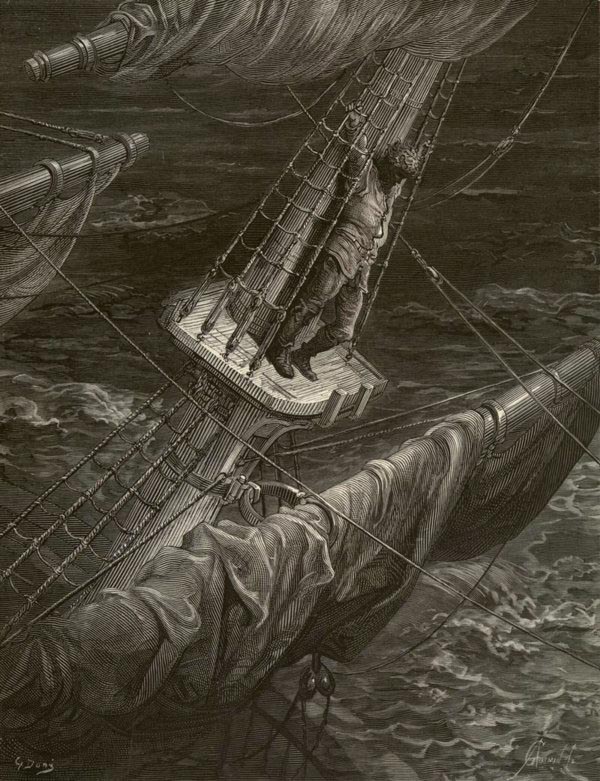
Samuel Taylor Coleridge’s The Rime of the Ancient Mariner is a haunting and influential work of English Romantic poetry. First published in 1798 as part of Lyrical Ballads, the joint collection with William Wordsworth that helped launch the Romantic movement, the poem combines supernatural storytelling with moral and philosophical depth. It has captured readers’ imaginations for more than two centuries with its vivid imagery, archaic language, and universal themes.
The poem tells the story of an old sailor who stops a wedding guest to recount a tale from his past. Against the listener’s will, the mariner compels him to hear his confession. The mariner describes how, on a sea voyage, he impulsively killed an albatross, a bird that had brought good fortune to his ship. This act of violence against nature unleashes catastrophe: the ship becomes cursed, the crew suffers from thirst and despair, and spectral forces take control of their fate. The sailors perish, leaving the mariner alone to wander the seas in torment. His eventual salvation comes only after he blesses the natural world around him, sea snakes gliding in the moonlight, with unforced love. This spontaneous recognition of beauty allows him to pray again, breaking the curse. Although he survives, he is doomed to roam the earth, retelling his story as a warning and moral lesson.
Understanding the importance of Coleridge’s poem requires considering its historical and literary context. At the end of the eighteenth century, poetry was undergoing a transformation. The Romantic movement sought to move away from rigid forms and rationalist ideals, instead emphasizing emotion, imagination, and the spiritual power of the natural world. The Rime of the Ancient Mariner embodies this shift: it is at once a seafaring ballad, a supernatural tale, and a meditation on humanity’s relationship with nature and the divine. Its archaic diction mimics old ballads, grounding it in folk tradition, while its philosophical weight and psychological intensity reveal Coleridge’s ambition to elevate the genre.
The poem is important not only as a cornerstone of Romantic literature but also as a work that continues to resonate with modern readers. Its central theme, that all living things are interconnected and that harming nature carries spiritual consequences, feels strikingly relevant in today’s world. The mariner’s guilt and need for redemption reflect broader human concerns about morality, responsibility, and forgiveness. At the same time, Coleridge’s use of the supernatural, like ghostly ships, spectral voices, and the figure of Death-in-Life, creates a gothic atmosphere that appeals to readers’ imaginations as much as to their moral sense.
Over time, The Rime of the Ancient Mariner has seeped into culture beyond the literary world. Its imagery has inspired countless painters, composers, and writers, while phrases like “albatross around one’s neck” have entered the English language as metaphors for burdens of guilt or regret. The poem’s endurance speaks to its complexity: it is at once a thrilling narrative, a spiritual allegory, and a profound reflection on the costs of disrupting the harmony between humanity and the natural world.
Coleridge’s mariner continues to tell his story across the centuries, holding listeners in thrall just as he held the wedding guest. His tale is a reminder that stories can wound, heal, and teach, and that literature has the power to bind us to questions of conscience that remain as urgent now as they were when the poem first appeared in 1798.




Leave a Reply