
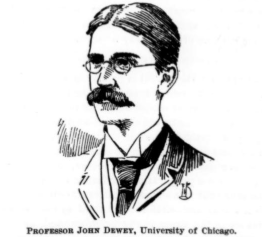
The works of John Dewey are still taught to aspiring educators worldwide. As an educational reformer, philosopher, and psychologist, John Dewey (not to be confused with Melvil Dewey of Dewey Decimal system fame) did extensive research and experimentation on the subject of education. When he was a professor at the newly-founded University of Chicago, he created the University of Chicago Laboratory Schools to test his educational hypotheses. In 1897, “my Pedagogic Creed” written by Dewey was published in the 54th volume of The School Journal. In it, he discusses his core ideas on teaching. He breaks his ideas down into five articles: “What Education Is,” “What the School Is,” “The Subject-Matter of Education,” “The Nature of Method,” and “The School and Social Progress.” Each paragraph starts with the statement of “I believe” to establish that he may or may not have all the answers and this is simply his own views on education. As he was the head of the Department of Philosophy, Psychology, and Education at the time, his views were majorly influential on the topic of education at the start of the 20th century.
Article One: What Education Is
Dewey starts this section by establishing that learning is a social process that begins at birth. As part of the human race, we are all learners. This learning forms a person’s way of thinking and “becomes an inheritor of the funded capital of civilization” by gaining access to the knowledge that has been found before them. He describes how a child learns by responding to social situations, developing a sense of belonging and understanding their role in a group. Language, for example, evolves from simple babbling into meaningful communication through social feedback “and thus the child is introduced into the consolidated wealth of ideas and emotions which are now summed up in language.” The first learning journey any individual goes through is how to be a human being in society.
He then goes on to describe the two sides of the educational process one goes through as a child: the psychological (a child’s instincts and interests) and sociological (how those instincts fit into society). Dewey believes that the psychological is the basis for all learning, since “The child’s own instincts and powers furnish the material and give the starting point for all education.” Therefore, any instruction or teaching a child receives should be based in their own interests or they may not be receptive to learning it. To teach effectively, educators need to understand both a child’s instincts and how they relate to society. A child’s natural behaviors, like babbling, should be seen as the foundation for future skills, such as conversation.
Education, as Dewey writes, isn’t just about developing the mind or adapting to society; both must work together. A purely psychological approach lacks direction and “gives us only the idea of a development of all the mental powers without giving us any idea of the use to which these powers are put.” But, a purely social approach limits individual freedom and “results in subordinating the freedom of the individual to a preconceived social and political status.” Psychological interests of learners should lead what educators teach while the social implications of that teaching should help guide the educator on what aspects of the topic the learner should know.
Since the future is uncertain, education should equip students with the skills to think, adapt, and act effectively. This requires understanding each student’s abilities and shaping education around their potential for social contribution.
Article Two: What the School Is
Dewey believes that learning happens through participation in a community and society. School should help children use their abilities for social good while connecting them to the knowledge of past generations. While knowledge will help prepare them for the future, education “is a process of living and not a preparation for future living,” therefore “school must represent present life.” Since the future is uncertain, it is helpful to educate a child as it pertains to current, real-life scenarios. If education isn’t connected to real-life situations, it becomes dull and ineffective. However, since “Existing life is so complex that the child cannot be brought into contact with it without either confusion or distraction,” school should provide a smaller, more manageable version to help them develop without feeling overwhelmed.
When thinking about what a child should be introduced to at school, school learning should start with what students already know from home and “continue the activities with which the child is already familiar.” By engaging in familiar activities, children learn their meaning and their role in society. Connecting school lessons to past experiences helps children learn smoothly without sudden, confusing shifts. Since home is where children first learn the morals and values of their society, “It is the business of the school to deepen and extend his sense of the values bound up in his home life.” Dewey asserts that disrupting this flow of what is learned at home and what should be learned at school is why “much of present education fails.” If school is just about memorizing facts for later use, it doesn’t truly become part of a child’s lived experience.
Thus, the best way to develop morals is by working and thinking together in a school community. Learning and discipline should come naturally from being part of a group, not just from a teacher’s authority. Dewey states: “The teacher is not in the school to impose certain ideas or to form certain habits in the child, but is there as a member of the community to select the influences which shall affect the child and to assist him in properly responding to these influences.” Meaning, their role is to create a learning environment that influences students positively, not just to impose knowledge or habits. A well-functioning school encourages good behavior naturally through shared goals and teamwork. With their experience, teachers should guide students in handling life’s challenges. Grades and examinations, therefore, should measure how well students can contribute to and benefit from society, not just their ability to memorize facts.
Article Three: The Subject-Matter of Education
The growth and education of a child are naturally connected by their social experiences at home, in the school, and within their community, which in Dewey’s opinion give meaning to their learning efforts. Therefore, subjects should gradually emerge from a child’s experiences, not be separate from them. He states, “we violate the child’s nature and render difficult the best ethical results, by introducing the child too abruptly to a number of special studies… out of relation to this social life” and that the center of their learning should start with “the child’s own social activities.” Introducing isolated subjects, like reading or geography, too early without a direct link to their social experiences, makes learning harder.
Dewey describes some of the isolated subjects and why it is difficult to teach them outside of the contest of the child’s life. Later, he also gives reasons as to why these subjects are important.
- It is difficult to teach science as a subject since nature is diverse and fragmented. Teaching it as a single focus makes learning scattered rather than connected. It should, instead, “introduce a principle of radiation rather than one of concentration.” Science should explain how society works and focus on real-world materials and processes that shape human life. Instead of presenting it as a new subject, it should help students understand and improve experiences they already have.
- The focus of literature, as a subject, should demonstrate how literature reflects life. It should summarize and deepen experiences. He states that “we lose much of the value of literature and language studies because of our elimination of the social element.” While language is a way of delivering knowledge, it is also a tool for communication. It is a social tool for sharing ideas and emotions, not just a way to demonstrate learning.
- History should be taught in a way that demonstrates how social life grows and changes. If history is just about the past, it feels meaningless. Learning, as Dewey has demonstrated, should be based on the same hands-on, constructive work that built societies. Children should primarily learn by doing. To understand their cultural heritage, they must engage in real activities that shaped civilization. He emphasizes the importance of hands-on skills like cooking, sewing, and manual training that should not be extra subjects but the foundation of learning. These skills “represent, as types, fundamental forms of social activity.” They should not be treated as side subjects or hobbies but as essential learning tools.
There is no strict order for subjects in education. Learning should always include aspects of science, art, and communication from the start, rather than being divided by grade levels. Since education is an ongoing process, learning itself is both the journey and the goal. It is not just preparation for something else. Dewey believes that setting outside goals for education weakens the process and “deprive[s] the educational process of much of its meaning and tends to make us rely upon false and external stimuli in dealing with the child.” If education is only seen as a means to an external goal, it loses meaning and relies on artificial motivation.
Article Four: The Nature of Method
Education should follow a child’s natural development and teaching methods should align with how children grow and learn, not impose artificial structures. Children naturally express and move before they fully understand. Forcing them into passive learning too soon leads to wasted time and frustration. Logical thinking is rooted in problem-solving and action. Teaching abstract symbols without real-world application makes learning feel meaningless. Children learn best when they form their own mental images of concepts. He believes that more focus should be on developing imagination rather than memorization.
When forming a curriculum, “interests are the signs and symptoms of growing power.” Observing what children are curious about helps educators understand their growth and what they are ready to learn next. The role of the educator should also be to guide their interests, not to suppress or indulge. Ignoring interests weakens curiosity, but blindly following them leads to shallow learning. Educators should look deeper to understand what interests reveal.
He also discusses the purpose of emotions and that they “are the reflex of actions.” Feelings are a natural response to what we do. Trying to create emotions without meaningful action leads to artificial and unhealthy thinking. Sentimentalism is a danger in education; when emotions are separated from real learning and action, education becomes shallow, overly formal, or overly emotional without substance.
True learning happens when children engage in meaningful activities, not just by stimulating emotions or memorizing information. When education focuses too much on feelings without action, it becomes shallow and ineffective.
Article Five: The School and Social Progress
Dewey ultimately “believe[s] that education is the fundamental method of social progress and reform.” Laws, penalties, and structural changes alone cannot create lasting social change. Education is how a society grows and changes: “through education society can formulate its own purposes, can organize its own means and resources, and thus shape itself with definiteness and economy in the direction in which it wishes to move.” Therefore, the purpose of the school is to assist children in making sense of their own world and to act on their own accord through logical thinking and problem solving.
Education shapes social awareness, helping individuals contribute to a better society. It balances individual growth with social responsibility, as character develops within a community. The ideal school harmonizes personal development and collective progress. Society’s greatest moral duty is to support education as the best tool for shaping the future. When society understands education’s power, it will invest heavily in it. Those who care about education must advocate for schools as the main driver of social progress.
Education blends science and art in the most profound way. Teaching is the highest form of art, requiring deep insight, empathy, and skill. Advances in psychology and social science enhance education, making it more effective. When science and art unite in education, human potential is fully realized. Teachers are not only here to instruct individuals, “but in the formation of the proper social life.” Teachers must recognize their important role as builders of a just and thriving community. They are “a social servant set apart for the maintenance of proper social order and the securing of the right social growth.” Dewey invokes God and ultimately describes teaching as a sacred calling, guiding society toward truth and progress.
In Conclusion…
John Dewey’s “My Pedagogic Creed” remains influential because it emphasizes education as a dynamic, student-centered process that fosters both individual growth and social progress. His ideas on experiential learning, the importance of interests, and the role of education in shaping democracy continue to shape modern teaching philosophies. Many contemporary approaches, such as project-based learning and inquiry-based instruction, reflect his belief that education should be active, meaningful, and connected to real-life experiences. By advocating for schools as the foundation of social reform, Dewey’s work continues to inspire educators who strive to create inclusive, engaging, and socially responsible learning environments. His vision of education as a blend of science, art, and ethical responsibility ensures that his ideas remain relevant in today’s ever-evolving educational landscape.
You can read the full text here or here.
Interested in how to use these ideas as an ALT? Read this blog post.


 Sid in Japan
Leave a reply to Dewey’s “Pedagogic Creed” and the ALT – Sid in Japan Cancel reply