
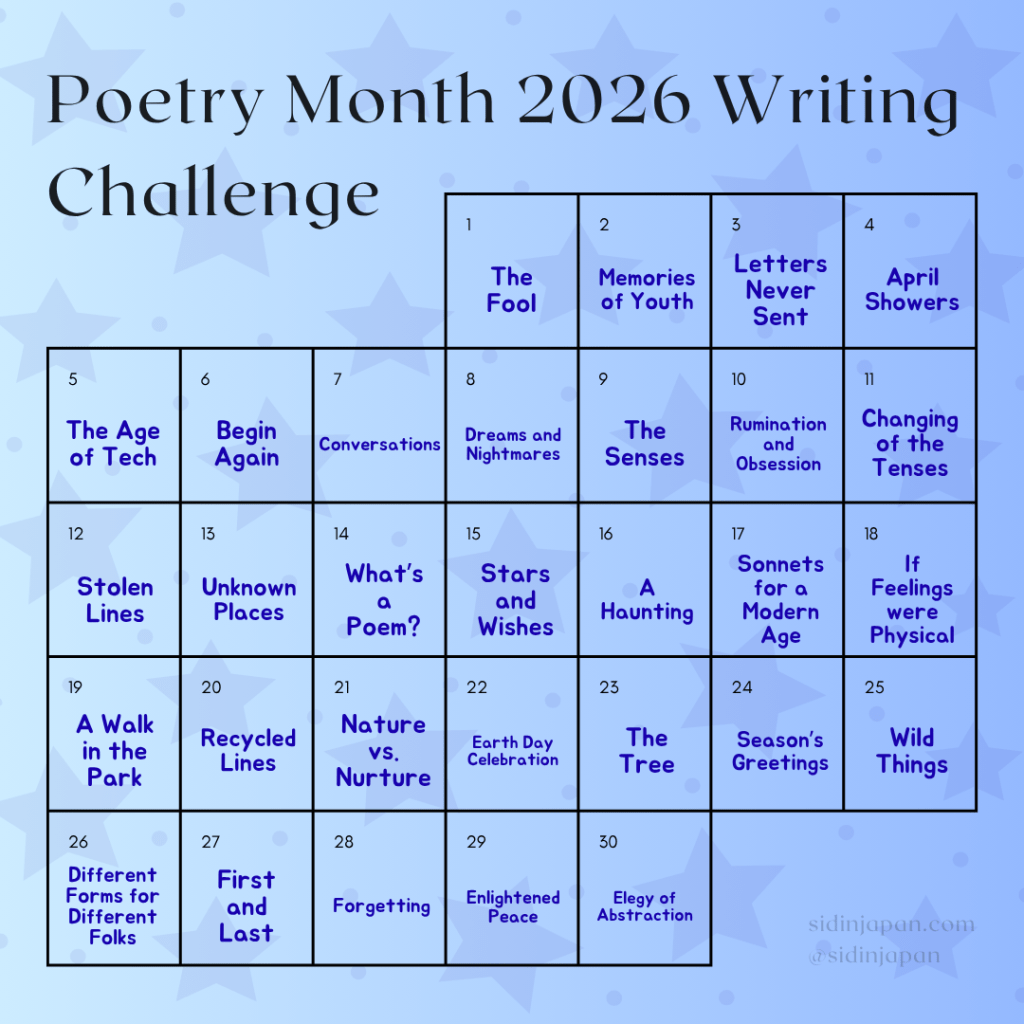
- April 2026 Poetry Challenge
- April 1 – The Fool
- April 2 – Memories of Youth
- April 3 – Letters Never Sent
- April 4 – April Showers
- April 5 – The Age of Tech
- April 6 – Begin Again
- April 7 – Conversations
- April 8 – Dreams and Nightmares
- April 9 – The Senses
- April 10 – Rumination and Obsession
- April 11 – Changing of the Tenses
- April 12 – Stolen Lines
- April 13 – Unknown Places
- April 14 – What’s a Poem?
- April 15 – Stars and Wishes
- April 16 – A Haunting
- April 17 – Sonnets for a Modern Age
- April 18 – If Feelings were Physical
- April 19 – A Walk in the Park
- April 20 – Recycled Lines
- April 21 – Nature vs. Nurture
- April 22 – Earth Day Celebration
- April 23 – The Tree
- April 24 – Season’s Greetings
- April 25 – Wild Things
- April 26 – Different Forms for Different Folks
- April 27 – First and Last
- April 28 – Forgetting
- April 29 – Enlightened Peace
- April 30 – Elegy of Abstraction
- Let’s Write!
Spring is here! The sakura have finally started blooming in my little village and we’re getting ready to start a new school year. What better way to celebrate than by appreciating poetry!
National Poetry Month is an annual celebration of poetry held every April in the United States and Canada. It was established in 1996 by the Academy of American Poets to raise awareness and appreciation of poetry and its role in culture. This year marks National Poetry Month’s 30th anniversary!
The idea was inspired by other month-long cultural observances like Black History Month and Women’s History Month, with the goal of creating a dedicated time when poets, teachers, students, and communities could focus on reading, writing, and sharing poetry. Today, it has grown into the largest literary celebration in the world, involving millions of people through events such as poetry readings, classroom activities, festivals, and initiatives like “Poem-a-Day” (which I highly recommend, it’s my favorite daily newsletter).
Poetry Month is about encouraging people to engage with poetry; whether by discovering new poets, revisiting classic works, or writing their own. Personally, I try to write a new poem every day (most of which will never see the light of day). But, for this month, I wanted to share some of my poems with the world and hopefully try to inspire others to engage with poetry every day!
April 2026 Poetry Challenge
April is the perfect time to write; everything is changing, growing, starting over a little. This challenge is just a simple way to tap into that. One poem a day, using a different prompt to get you going.
Some days are more reflective, some are weird or experimental, and some might push you a bit outside your comfort zone. That’s the point. You don’t need to write anything perfect. Just show up, try something, and see where it goes. By the end of the month, you’ll have a whole collection of poems (even if some are messy), and a better sense of your own voice.
April 1 – The Fool
Draw inspiration from The Fool tarot card, a symbol of beginnings, curiosity, and stepping into the unknown. Let the poem explore what it means to start a journey without certainty.
April 2 – Memories of Youth
Write about a memory from childhood, whether it’s vivid or half-forgotten.
April 3 – Letters Never Sent
Write an epistolary poem: write your poem as a letter to someone (or something) you’ll never send it to.
An epistolary is a form of creative writing that is comprised of letters.
April 4 – April Showers
Write about rain, storms, the feeling of wet weather, or the May flowers.
April 5 – The Age of Tech
Explore technology in any form, ancient or modern. Consider how it shapes connection, identity, or the way we move through the world.
April 6 – Begin Again
Focus on beginnings: fresh starts, small resets, or major life changes. Think of first days, blooming things, or the quiet courage it takes to start over.
April 7 – Conversations
Write your poem as a conversation between two voices. It could be between people, ideas, or even parts of yourself.
April 8 – Dreams and Nightmares
Draw from dreams, whether beautiful, surreal, or unsettling.
April 9 – The Senses
Ground your poem in sensory detail: sight, sound, smell, taste, and touch. Let physical experience drive your writing.
April 10 – Rumination and Obsession
Use a villanelle or another repetitive structure to capture looping thoughts. Focus on something that won’t leave your mind.
A villanelle is a highly structured poem built on repetition and rhythm. It has 19 lines: 5 tercets (3-line stanzas) followed by a final quatrain (4 lines).
April 11 – Changing of the Tenses
Write using past, present, and future tense within the same poem.
April 12 – Stolen Lines
Utilize lines or phrases from other sources: books, movies, songs, or conversations. Let them guide your writing and transform them into something new.
April 13 – Unknown Places
Write about a place you’ve never been, real or imagined.
April 14 – What’s a Poem?
Write a poem made entirely of questions.
April 15 – Stars and Wishes
Reflect on what has gone well and what you hope for.
April 16 – A Haunting
Write about something that lingers: ghostly or metaphorical. It could be a place, a memory, or a feeling that won’t leave.
April 17 – Sonnets for a Modern Age
Write a sonnet about something contemporary.
April 18 – If Feelings were Physical
Turn an emotion into something tangible. It might live in the body or take on a life of its own.
April 19 – A Walk in the Park
Describe a walk through nature, focusing on movement and observation. Better yet, write this while outside!
April 20 – Recycled Lines
Create a found poem using existing text: cut, rearranged, or erased. Let the original material transform into something unexpected.
April 21 – Nature vs. Nurture
Explore the tension between what we’re born with and what shapes us.
April 22 – Earth Day Celebration
Happy Earth Day! Write a poem that honors the Earth.
April 23 – The Tree
Write from the perspective of a tree.
April 24 – Season’s Greetings
Focus on a season of your choice.
April 25 – Wild Things
Write about what “wild” means to you. It could be nature, emotion, freedom, or something untamed within yourself.
April 26 – Different Forms for Different Folks
Write your poem in an unconventional format, like a recipe, memo, or grocery list.
April 27 – First and Last
Begin and end your poem with the same line.
April 28 – Forgetting
Write about memory fading or being lost.
April 29 – Enlightened Peace
Happy Showa Day! “Showa” roughly translates to “enlightened peace.” Reflect on peace, resilience, or renewal after hardship.
April 30 – Elegy of Abstraction
An elegy is a poem of mourning, traditionally written to honor someone who has died. It often reflects on loss, grief, memory, and the passage of time. Write an elegy for something intangible, like time, innocence, or silence. Mourn it as if it were something you could hold.
Let’s Write!
I hope you all enjoy this April challenge! If you use these prompts or not, comment down below on how your Poetry Month is going!

 Sid in Japan
Leave a comment