
Originally presented at the Nagano All-JET Conference in Matsumoto on October 17, 2024.
Goal setting is important for both general life and in the context of job hunting because it provides direction, focus, and motivation to achieve desired outcomes. In life, setting goals helps individuals prioritize their time and efforts, aligning daily actions with long-term aspirations. It fosters a sense of purpose and achievement, driving personal growth and fulfillment. In job hunting, goals help define a clear career path and identify steps needed to reach specific positions or industries. Goal setting also enables measurable progress, allowing for adjustments and persistence in the face of obstacles.
Read more: Goal Setting & Job HuntingGrowth Mindset
The growth mindset is a concept developed by psychologist Carol Dweck, which suggests that people who believe their abilities and intelligence can be developed through hard work, learning, and persistence are more likely to achieve success. In contrast, those with a fixed mindset believe that abilities and intelligence are static, leading them to avoid challenges and give up more easily when faced with obstacles.
Here are the key aspects of the growth mindset:
- Embracing Challenges: People with a growth mindset see challenges as opportunities to learn and grow, rather than as threats to their abilities. They understand that overcoming difficulties helps them improve.
- Persistence in the Face of Obstacles: Setbacks and failures are viewed as part of the learning process. Instead of giving up, individuals with a growth mindset persist and find new strategies to overcome difficulties.
- Effort Leads to Mastery: Effort is seen as the path to improvement. Instead of believing that talent alone leads to success, a growth mindset emphasizes the importance of hard work and dedication in mastering skills.
- Learning from Criticism: Constructive feedback is valued as a tool for growth. Individuals with a growth mindset are open to criticism because they see it as a way to identify areas for improvement.
- Inspiration from Others’ Success: Rather than feeling threatened by others’ achievements, people with a growth mindset are inspired by them. They recognize that others’ success is proof that growth and success are possible through effort and learning.
In the context of goal setting and job hunting, adopting a growth mindset can help you approach challenges, setbacks, and new opportunities with optimism and resilience. It encourages continuous self-improvement and skill-building, making you more adaptable and better equipped to handle the uncertainties of career transitions or job applications.
Overview: SMART Goals
SMART stands for Specific, Measurable, Achievable, Relevant, and Time-bound. SMART goals help create clear, focused objectives. By ensuring goals are specific, measurable, and time-bound, it becomes easier to track progress. They are designed to be realistic and relevant to your overall aspirations.

SMART Goal Examples
I want to learn 300 new vocabulary words in the next 6 months. I will study 50 new words each month by using flashcards and studying for 30 minutes each day.
- Specific: The goal is clearly defined.
- Measurable: 50 words per month and 30 minutes a day are ways to track progress.
- Achievable: 30 minutes a day is easy to commit to and 50 new words a month is not inaccessable.
- Relevant: Japanese is a useful tool when living in Japan.
- Time-bound: The end goal is set in 6 months time.
I will start a personal blog and publish one post a week about my experiences living abroad. I will launch the blog within the next two weeks and maintain the posting schedule for the next 16 weeks.
I will attend one local or cultural event per month to help me integrate better into the community. I will write a journal entry after each event reflecting on what I learned about the culture.
Not so SMART Goal Examples
I want to learn a bunch of new vocabulary words.
- Specific: While the goal (learn vocabulary) is clear, it is still vague (a bunch).
- Measurable: “A bunch” does not clearly state how much you want to learn in the end.
- Achievable: While learning new vocabulary is acheivable, since the goal is not clearly defined then you may not feel as though you ever reach the end.
- Relevant: Honestly? Still pretty relevant!
- Time-bound: Ther is not an appropriate end-time for your goal. If there’s no clear end, how will you know when you reach it?
I want to start a blog about living abroad.
- Missing time-bound and measurable parameters to track progress.
I want to learn more about the local culture.
- Not specific and missing a measurable parameter.
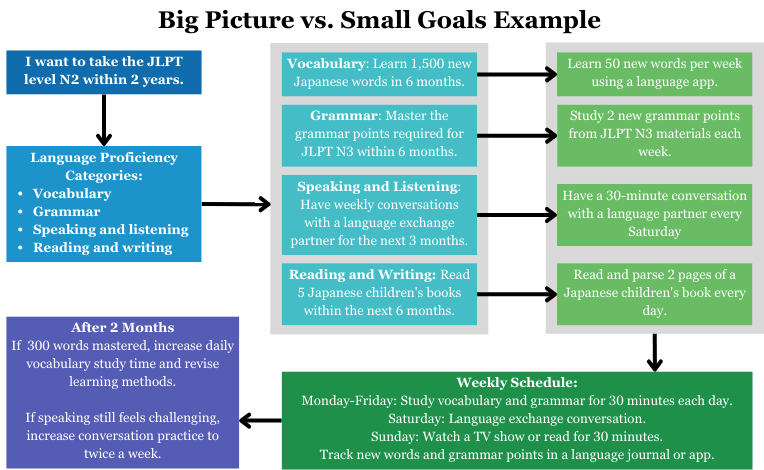
Overview: Big Picture vs. Small Goals
This method emphasizes balancing long-term, overarching goals (the “big picture”) with smaller, manageable tasks (“small goals”). Breaking large goals into smaller steps makes them less overwhelming and provides motivation as each small goal is achieved, keeping you on track to reach the larger objective.
Big Picture Goals and How to Break Them Down
- Start by identifying a broad, long-term goal. This should represent a significant milestone or achievement that may take months or even years to accomplish.
- Divide the big picture goal into key areas or categories that contribute to achieving the overall goal. These categories should represent different aspects of the goal.
- For each category, set medium-term goals that you can work on over a few months. These are milestones that will mark your progress toward the big picture goal.
- Once you have medium-term goals, break them down further into weekly or daily tasks. These small, actionable goals help you make consistent progress.
- Create a schedule that outlines when you’ll complete each small goal. This could be done using a planner, app, or journal. Tracking your progress helps ensure you stay on track and provides a sense of accomplishment as you achieve each step.
- Every few weeks or months, review your progress and adjust your smaller goals if necessary. You might find that some areas need more attention or that you can accelerate your learning in others.
Overview: Visual Goal Representation
This involves using visual tools like vision boards, mind maps, or goal trackers to make your goals tangible. Visualizing goals can help clarify priorities, maintain focus, and provide motivation as you can see your progress or the final result you’re aiming for.
- Vision Boards
- Progress Trackers
- Bullet Journals
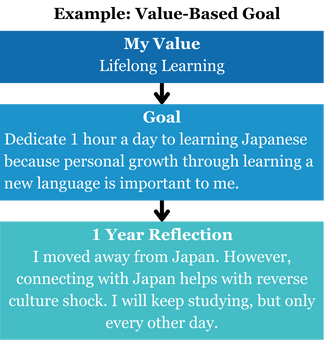
Overview: Value-Based Goal Setting
- Identify Your Core Values: Start by reflecting on what’s most important to you. These might be things like personal growth, family, creativity, community, or health.
- Connect Values to Goals: Once you’ve identified your values, the next step is to create goals that embody or support those values. For example, if one of your core values is “learning,” your goal might be to take a new course or read more books to grow your knowledge.
- Evaluate Goal Alignment: Regularly assess whether your goals still align with your values. Sometimes priorities shift, and it’s important to recalibrate as needed.
- Focus on the Journey, Not Just the Outcome: In value-based goal setting, the focus is not just on achieving the goal but on living according to your values throughout the process.
Example Values
- Achievement – Setting and accomplishing high goals.
- Adventure – Seeking out new experiences and challenges.
- Authenticity – Being true to oneself.
- Balance – Maintaining equilibrium between different aspects of life (work, family, hobbies).
- Collaboration – Working with others toward common goals.
- Community – Contributing to and participating in a group or society.
- Compassion – Caring for others and helping those in need.
- Courage – Facing fears and challenges with bravery.
- Creativity – Engaging in creative activities or thinking outside the box.
- Curiosity – A desire to learn and explore.
- Exploration – Taking time to discover and experience new places, things, and sensations.
- Fairness – Ensuring justice and equality.
- Family – Prioritizing relationships with family members.
- Freedom – Prioritizing the ability to make choices for yourself.
- Generosity – Sharing your resources and time with others.
- Gratitude – Being thankful for what you have and experience.
- Growth – Focusing on personal and professional development.
- Health – Maintaining physical and mental well-being.
- Humility – Being modest and not seeking undue praise or attention.
- Humor – Enjoying and finding lightness in life through laughter.
- Independence – Valuing self-sufficiency and autonomy.
- Innovation – Constantly striving to improve and create new ideas.
- Integrity – Acting in accordance with moral and ethical principles.
- Love – Fostering deep and meaningful relationships.
- Patience – Understanding the importance of waiting and endurance.
- Respect – Treating others with consideration and honor.
- Responsibility – Being accountable for one’s actions and duties.
- Security – Ensuring stability and safety in life.
- Spirituality – Prioritizing spiritual growth or connection to something greater.
- Sustainability – Taking actions that preserve and protect the environment.
- Wisdom – Valuing knowledge and insight gained through experience.
Overview: Gap Analysis
Gap analysis goal setting is a method that helps you identify the difference between where you are currently and where you want to be, then create actionable steps to bridge that gap. In the context of job searching, gap analysis involves evaluating your current skills, qualifications, and experience in relation to the requirements of your target job. Gap analysis clarifies what your need to work on, guides your professional development, and makes you a stronger job canidate overall. It can also make your job search more targeted, efficient, and goal-oriented.
Reflecting on Your Expereince (as a JET)
- During your time on JET, what goals have you accomplished?
- What actions were effective in achieving those goals?
- What skills you want to work on while you’re on JET?
- What goals do you wish to accomplish?
- What have you learned about your work self during your experience on the JET program?
- What skills have you gained during your time here?
Further Reading
Growth Mindset
- Carol Dweck (Harvard Business Review), “What Having a “Growth Mindset” Actually Means” – https://hbr.org/2016/01/what-having-a-growth-mindset-actually-means
- Carol Dweck (TED Talks), “The power of believing that you can improve” – https://www.ted.com/talks/carol_dweck_the_power_of_believing_that_you_can_improve/transcript?subtitle=en
- Betsy Ng (U.S. National Library of Medicine), “The Neuroscience of Growth Mindset and Intrinsic Motivation” – https://www.ncbi.nlm.nih.gov/pmc/articles/PMC5836039/
SMART Goals
- Kimberlee Leonard and Rob Watts (Forbes), “The Ultimate Guide To S.M.A.R.T. Goals” – https://www.forbes.com/advisor/business/smart-goals/
- University of California, “SMART Goals: A How-To Guide” – https://www.ucop.edu/local-human-resources/_files/performance-appraisal/How%20to%20write%20SMART%20Goals%20v2.pdf
- Joanne Genewick (Mayo Clinic), “Setting SMART goals for success” – https://www.mayoclinichealthsystem.org/hometown-health/speaking-of-health/setting-smart-goals
Values-Based Goals
- Bryant D Nielson (Medium), “Values-Based Goal Setting: How to Choose Goals That Matter” – https://medium.com/legthen-your-stride/values-based-goal-setting-how-to-choose-goals-that-matter-c18ec9e9389a
- Darya Sinusoid (Shortform), “How to Set Value-Based Goals (Instead of Desire-Based Goals)” – https://www.shortform.com/blog/value-based-goals/
Gap Analysis
- Kimberlee Leonard, Cassie Bottorff, Rob Watts (Forbes), “Conducting A Gap Analysis: A Four-Step Template” – https://www.forbes.com/advisor/business/gap-analysis-template/
Western Resumes
- Alison Green (Ask a Manager), “My Step-by-Step Guide to Writing a Resume” – https://www.askamanager.org/2020/02/my-step-by-step-guide-to-writing-a-resume.html
- Paige Cohen (Harvard Business Review), “How to Write a Resume That Stands Out” – https://hbr.org/2022/05/how-to-write-a-resume-that-will-stand-out
Japanese Resumes
- Daijob, “Find a Job in Japan, Tips & Advice – Japanese Resume” – https://www.daijob.com/en/guide/tipsadvice/resume/rirekisyo/
- Andrew Smith (GaijinPot), “How to Write a Japanese Resume” – https://blog.gaijinpot.com/write-japanese-resume/
Interviewing
- Molly Triffin (Forbes), “How To Spin A Jack-Of-All-Trades Work Experience Into A Career Advantage” – https://www.forbes.com/sites/learnvest/2016/04/06/how-to-spin-a-jack-of-all-trades-work-experience-into-a-career-advantage/
- Natalie Jesionka (The Muse), “How to Talk About Your Experience Abroad in Your Job Hunt” – https://www.themuse.com/advice/how-to-talk-about-your-experience-abroad-in-your-job-hunt

 Sid in Japan
Leave a comment